ATTENTION, PEOPLE WHO KNOW WHERE THE TAKEOUT MENUS ARE BUT NOT THE WATER SHUTOFF!
PEOPLE WHO CAN IDENTIFY A DELIVERY APP BY ITS NOTIFICATION SOUND BUT HAVE NEVER ESTABLISHED WHETHER THE THING ON THE CEILING IS A SMOKE ALARM OR A SMALL ROUND ORNAMENT!
Are you tired of not having an evening that begins with the words, “I thought that switch did something”?
Have you spent another comfortable night inside a building full of water, current, heat, gas and stairs, quietly assuming all five have agreed to behave?
Then congratulations.
For the next several minutes, you are eligible to receive the Five Number One Rules of a Home That Doesn’t Invent Emergencies, a complete domestic safety system containing not one, not two, but FIVE NUMBER ONE RULES.
“Wait,” you’re yelling at the screen, “they can’t all be Number One!”
That’s exactly what Big Numbering wants — a smoke alarm covering for a bad exit plan, a clean dryer vent negotiating with electricity.
Domestic accidents are specialists.
Detection can’t carry anybody outside.
An exit can’t stop a ground fault.
A GFCI can’t make a ladder stable.
Maintenance can’t turn an improvised repair into qualified electrical work.
Not one of them pays another one’s bill.
Occupations learned this the expensive way, one accident at a time, and then wrote it down: lock out the energy, guard the edge, and don’t let the second person go in after the first.
So here they are.
Five rules.
Five Number Ones.
No substitutions. No confidence-based wiring. No ceremonial pressing of a button that proves only the button is still emotionally available.
RULE #1: DETECT FIRE AND CARBON MONOXIDE BEFORE YOUR SENSES CAN
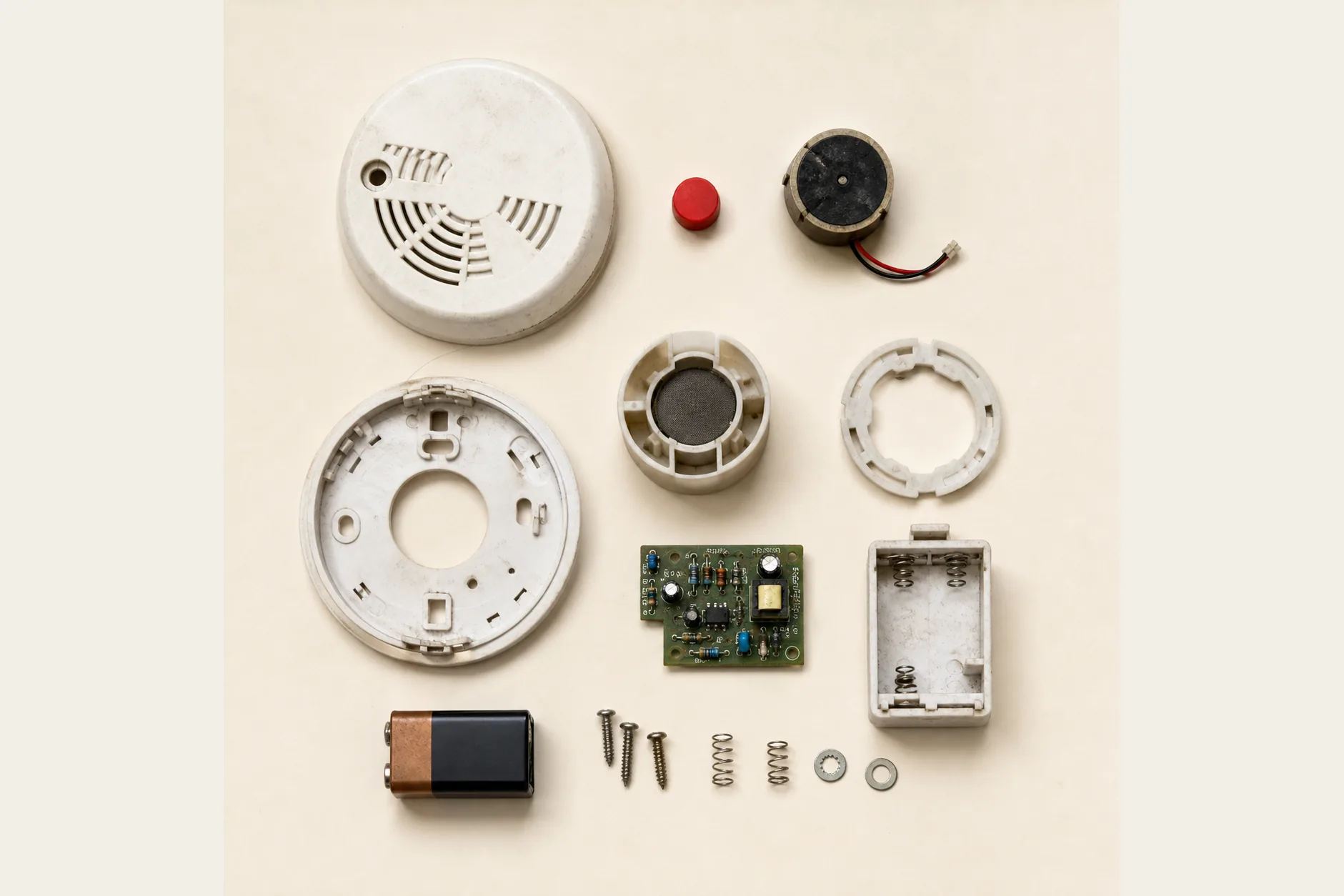
Presenting CEILING-DISC-DELUXE™, the revolutionary household accessory that does nothing whatsoever until the one moment when doing nothing is an unacceptable business model.
Here’s the thing nobody tells you about the disc.
It has three jobs.
They run on three different clocks.
Test it monthly, using its own button.
Replace the battery once a year — or the moment it starts chirping at 4 a.m., because that is the only hour it knows.
Replace the entire alarm every ten years. Even when the button still works. NFPA has recommended that since 1999, because sensor sensitivity degrades in ways a button cannot reveal.
The button is an audition.
It isn’t the performance.
Does the difference show up anywhere real? In NFPA data for 2009–2013, homes with working smoke alarms saw 0.53 deaths per 100 reported home fires. Homes without saw 1.18. Meanwhile, an estimated 30% of UK smoke alarms have dead or removed batteries.
Owning a thing and maintaining the conditions under which it works are two different hobbies.
Carbon monoxide needs its own logic, because carbon monoxide is a different problem wearing the same shape of plastic.
Put an alarm in each sleeping area.
Then press its button and understand precisely what you have learned. The battery is fine. The circuit is fine. The buzzer is fine.
You have learned nothing about whether the sensing element still detects gas.
The sensor has a service life of its own. Electrochemical sensors run roughly 5 to 10 years. Biomimetic, about 6. Cheaper general-purpose sensors can be finished at 2. Read the device’s own instruction — it is the only document that knows which of those you bought.
Whether your locality requires any of this varies, and that is worth knowing. It changes the law. It does not change what a house with a fuel-burning appliance, an attached garage or a generator owes the people asleep inside it. The CDC attributes more than 400 non-fire CO deaths, over 20,000 emergency-room visits and more than 40,000 people seeking medical attention every year in the United States to a gas that announces nothing.
A detector is not a charm. It is a maintained instrument, and every component in it has a separate job.
You buy safety equipment once. You own a working safety system continuously.
RULE #1: KEEP A VIABLE EXIT AND A PLACE TO MEET
And now, from the makers of “WE’LL FIGURE IT OUT WHEN THERE’S VISIBLE SMOKE,” comes ESCAPE-PLAN-AT-THE-WORST-POSSIBLE-MOMENT™.
It replaces every useful decision with a dark hallway, a shrieking alarm, and the complete cognitive bandwidth of a startled squirrel.
Every sleeping area needs a way out.
Not a way out on the floor plan.
A way out that opens.
That the person in that room can actually operate, at night, in the dark, possibly while carrying someone smaller.
That leads somewhere which is not itself a second emergency.
Then pick the meeting place. Outside. Before you need it.
Here’s why, and the reason isn’t abstract.
The alarm goes off. Everybody gets out — by different routes, which is the entire point of having more than one. Dad reaches the driveway and doesn’t see Emma. Emma’s on the front lawn not seeing Dad.
So Dad goes back in.
Congratulations. You have just manufactured a casualty out of a successful evacuation.
That failure mode’s documented, not hypothetical. A 1986 NIOSH alert on confined spaces found that more than 60% of the fatalities were would-be rescuers who entered after the first person went down. A house fire isn’t a permit-required confined space. The arithmetic is identical.
A meeting place is how a household answers one question fast: who’s out, and who isn’t.
While things are calm, find the main water shutoff. Then make sure the people who might need it also know where it is — a shutoff only one person can locate is a shutoff that works when that person is home.
None of this is an invitation to start operating gas or electrical equipment beyond what its own instructions permit. It is an instruction to replace a frantic search with something you already know, and to hand the rest to the emergency service whose job it actually is.
An exit takes a body out of danger. A meeting place stops uncertainty from sending one back in.
The most heroic object in the house is usually a boring agreement made on an ordinary evening.
RULE #1: TREAT WATER, CURRENT, HEAT AND HEIGHT AS SEPARATE SYSTEMS
BEHOLD ONE-SIZE-FITS-ALL-CAUTION™.
One vague warning label.
Applied to a shower valve, an outlet, a ladder, and the eternal human need to carry three awkward things upstairs at once.
It has no settings, because it has no plan.
Start with the device that knows exactly one electrical problem and knows it extremely well.
A GFCI watches for an imbalance between hot and neutral and cuts power at roughly 4 to 6 milliamperes. That is far below anything a standard breaker considers its business, and uncomfortably close to the range where current through a human being can cause ventricular fibrillation.
That’s what it does.
That’s all it does.
It’s ground-fault protection, not a general amnesty for damaged cords and improvised repairs.
The National Electrical Code has spent decades adding rooms to its list — pool lighting in 1968, bathrooms and outdoor receptacles in 1975, garages in 1978, kitchen countertops in 1987, unfinished basements and crawl spaces in 1990, whole kitchens in the 2023 edition. What’s enforceable where you live depends on which edition your locality adopted. Test yours on whatever schedule its own label specifies.
Heat is a genuine tradeoff, and anybody who hands you a single correct number is selling something.
Water at 155°F can cause a serious burn in about one second. At 140°F, five seconds. At 133°F, fifteen. At 125°F, about ninety.
So: turn it down.
Except that Legionella grows best between 77°F and 113°F, peaks around 95°F, and is not killed until roughly 140°F.
So: turn it up.
Both instructions are correct. They’re answers to different questions. Which is why ASHRAE revised its guidance in 1988 toward storing water hot and fitting a tempering valve to deliver it cooler at the tap.
The valve is where the system stops pretending those two needs are the same need.
Height resists good intentions in its own way. Keep three of four limbs on the ladder — two hands and a foot, or two feet and a hand. Match the duty rating to the climber plus the tools plus the materials. U.S. ladders run from Type III at 200 lb up to Type IAA at 375 lb.
A rating that can’t carry the whole load hasn’t quietly become adequate because the job is small.
A hazard does not become one category just because it lives in one house. Water, current, heat and height each need the control that actually addresses them.
The house isn’t “basically safe.” It’s four or five systems taking turns being unforgiving.
RULE #1: MAINTAIN THE BARRIER BEFORE THE ORDINARY DAY NEEDS IT
Introducing NOTHING-HAS-HAPPENED-YET PRO™, the subscription service that charges nothing at all, for years, and then bills you in smoke, water, gravity, or a genuinely spectacular noise from behind a wall.
Maintenance isn’t an annual conversation with a flashlight.
It’s keeping the things that interrupt an ordinary failure in the condition where they can still interrupt it.
Clean the lint filter after every load.
Every load.
The one you’re about to skip is a load.
Clean the vent duct at regular intervals — and notice how much work “regular” is doing in that sentence. Underwriters Laboratories does not specify an interval. “Annually” is common consumer advice, not a UL rule, and it’s worth knowing which of the two you’re repeating.
The U.S. Fire Administration estimated 2,900 home clothes-dryer fires a year in 2008–2010: 5 deaths, 100 injuries, $35 million in property loss. Failure to clean was the contributing factor in 34% of them.
Then there is the kitchen, which is less a subtle hazard than a statistically dominant one. In USFA data for 2017–2019, cooking accounted for 50.9% of residential fires with a determined cause. Heating equipment, 9.3%. Electrical malfunction, 6.7%. Smoking materials, 2.0%.
Half of it is the room you’re already standing in, doing the thing you’ve done a thousand times.
Occupational safety makes the underlying point with less domestic furniture in the way. OSHA’s lockout/tagout rule requires machinery to be de-energized and physically locked before service. Not switched off. Locked. OSHA estimates the standard prevents roughly 120 fatalities and 50,000 injuries a year.
Your kitchen isn’t a factory. The lesson is narrower than that, and it travels:
A switch position isn’t a barrier.
And a procedure that only works if everybody remembers perfectly, forever, isn’t much of one either.
The same holds for height. OSHA’s construction rule calls for guardrails, nets or fall arrest at six feet. In 2024, 389 of 1,034 construction fatalities were falls to a lower level. Nobody is suggesting you clip into a harness to change a bulb. The point is that a stable ladder, clear footing, a working rail, and a decision not to reach eighteen inches further than the equipment allows are all barriers that exist before the moment when balance has to become a plan.
Maintenance is the work that keeps yesterday’s barrier from becoming today’s prop.
The loose stair doesn’t become less loose because the household has learned to step over it.
RULE #1: CALL THE QUALIFIED PERSON BEFORE IMPROVISATION BECOMES A TRADE
AND NOW: CERTIFIED-BY-CONFIDENCE™ — the wrench set that converts one video, one switched-off breaker, and one sentence beginning “how hard can it be” into an entirely new professional identity.
There’s a line between an ordinary household task and work whose failure releases energy, compromises structure, defeats code, or puts a person somewhere a mistake can’t be taken back.
Exactly where that line sits depends on the job and on local licensing, so nobody gets to hand you a universal threshold.
The question’s concrete enough anyway.
Does this job ask me to diagnose or alter gas, serious electrical systems, or structure?
Does it put me at a height I can’t control with equipment I actually own?
Is there any part of this where I would be relying on the thing being off, without being able to verify that it’s off?
If so, the qualified person arrives before the improvisation does.
Which brings us to the most useful thing occupational safety has to say to a homeowner, and it arrives as a warning about false analogies.
Lockout/tagout physically isolates energy before maintenance. That’s one situation.
Arc-flash protection addresses a completely different one: work that has to stay energized, where the hazard isn’t touching a conductor but standing near it when it fails.
Those aren’t two intensities of the same problem. They’re two unrelated problems filed under the same word.
Which is the whole lesson, and it’s short.
“Electricity” isn’t one hazard.
And “off” isn’t automatically a verified safe state.
Skill is knowing what you can handle. Judgment is knowing which hazards never get to become a learning project.
The most useful tool in the box is sometimes a phone call made before the box comes out.
BUT WAIT, THERE’S MORE!
“What about renters?”
Same rules. Test what’s there, learn the exits, find the controls you’re allowed to touch, and use the landlord, the building, the emergency service or the trade for the rest.
“What about an old house?”
Same rules. Local code adoption differs and old work won’t match a new edition of anything. Detection, exits, maintenance and respect for energy don’t become optional because a wall is charming.
“What about children? Older adults? Guests? Somebody who can’t hear an alarm?”
Same rules — but they only count as satisfied if they work for the actual people in the actual house. An alarm nobody in the back bedroom can hear is a decorative ceiling puck.
“What about a power outage?”
Same rules. The details move: a generator adds CO risk, darkness rewrites every exit, and a system that’s temporarily unavailable changes the plan. Never run a portable generator indoors or in an attached garage.
“What about one extremely careful person?”
Same rules. The careful person will eventually be out, tired, carrying groceries, or thinking hard about something else. What you want is the barrier that still works on that day.
Safety is architecture for ordinary human beings having ordinary human days.
It isn’t a personality contest.
The details change.
The architecture doesn’t.
THE FIVE, WITH THE HOUSE LIGHTS UP
Detect fire and carbon monoxide before human senses can. Monthly test, annual battery, ten-year unit replacement, and CO sensors retired on their own stated service life.
Keep a viable exit from every sleeping area, agree on a meeting place outside, and know where the main shutoffs are before anything is wrong.
Treat water, current, heat and height as separate systems, each given the control that actually addresses it.
Maintain the barriers that stop ordinary failures: alarms, GFCIs, lint filters, ducts, clear access, stable footing, working rails.
Call the qualified person before a hazardous repair becomes an experiment.
DO THIS TONIGHT
You don’t need to buy anything. Walk the house once.
Press every smoke alarm button. Then turn the unit over and read its date.
Find every CO alarm and read its sensor-life instruction, rather than assuming the button told you the whole story.
Name the exit from each sleeping area out loud. Confirm it opens. Choose the place outside where everyone appears, and tell everyone.
Find the main water shutoff. Then tell somebody else where it is.
Test the GFCIs the way their own labels say to.
Look at what the water heater is actually set to, and whether there’s a tempering valve. Treat any change as a system question, not a dare with a thermometer.
Clean the lint filter. Look at the duct. Decide when it gets cleaned, and by whom.
Read the ladder’s rating before its next job — and put the tools and materials on the scale with you.
Then make one more list: everything that needs somebody else. The electrical work past what a receptacle’s instructions cover. The gas question. The structural question. The height you can’t control. The thing whose condition you genuinely can’t establish.
That last list is where a house stops asking an amateur to improvise around a hazard.
And in every room, ask one question:
“If something went wrong here, what would I desperately wish I had done yesterday?”
Then do that.
Tonight.
For the low, low price of paying attention before it becomes urgent, the complete Five Number One Rules system is yours.
No credit card. No subscription. No twelve easy payments.
Just a house with working warnings, known exits, maintained barriers, and considerably fewer ways for an ordinary evening to become a phone call somebody remembers for thirty years.
Operators are no longer standing by.
The operator lives here.