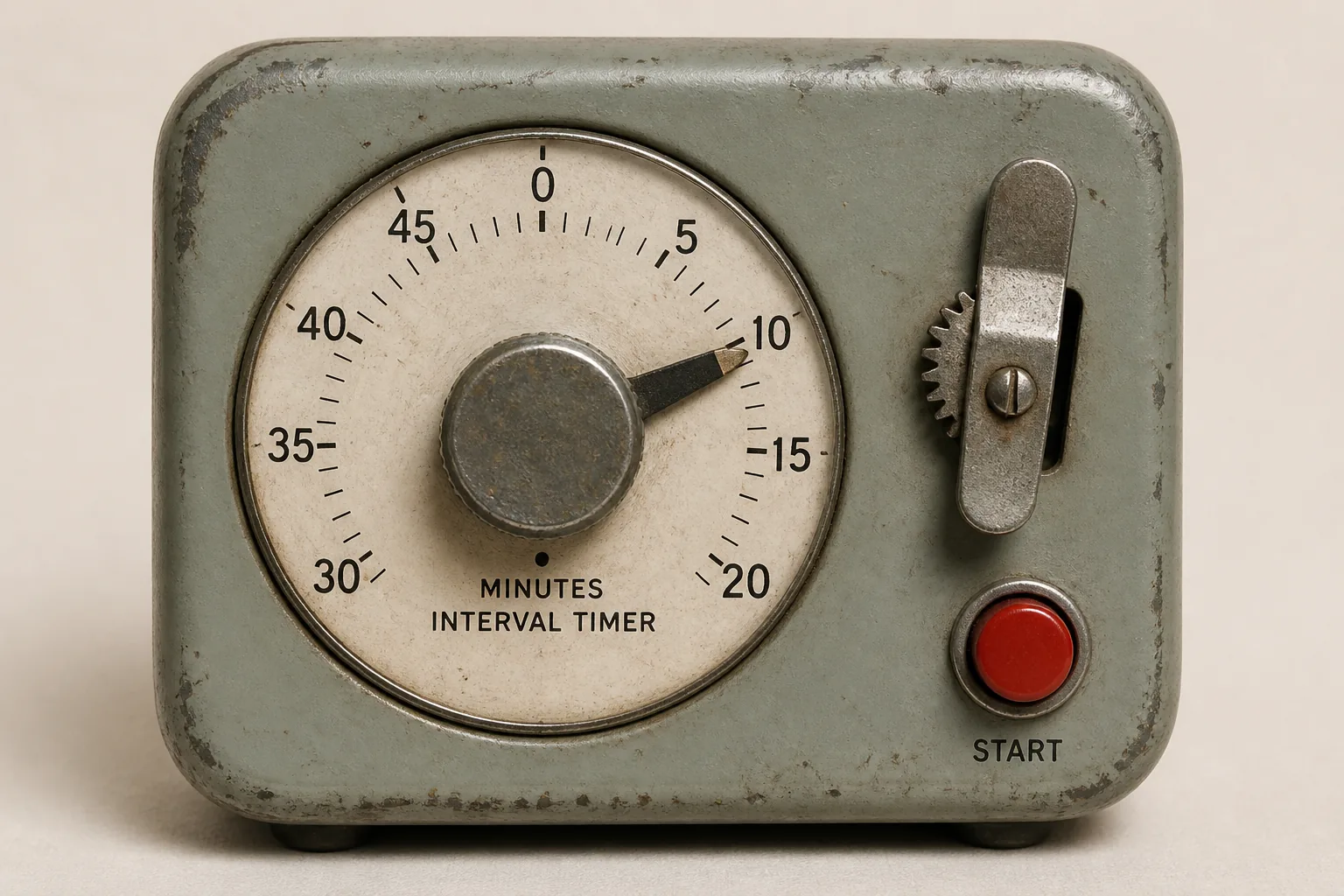
ATTENTION, PEOPLE WHO HAVE TRIED GTD, POMODORO, AND BUYING A NICER NOTEBOOK!
PEOPLE WITH A NOTES APP, A PAPER PLANNER, AND A FOLDER CALLED NEW SYSTEM!
Are you tired of not having the right productivity religion?
Have you wandered the sacred aisles of the stationery store, touched a notebook with a linen cover, and felt for one electrifying second that the notebook itself might begin replying to email?
Then congratulations.
You qualify for the Five Number One Rules of Productivity Without a Personal Religion, a complete work-management system containing not one, not two, but FIVE NUMBER ONE RULES.
It accepts GTD. Pomodoro. Timeboxing. An Eisenhower Matrix. And whatever small rectangular object has recently convinced the internet it is an operating system.
“Wait,” you’re yelling at the screen, “they can’t all be Number One!”
That’s exactly what Big Numbering wants: one glamorous habit that can be bought, defended online, and blamed the moment it meets a calendar with real obligations in it.
Useful work fails in specialist ways.
Capture can’t tell you what “work on proposal” means.
A crisp next action can’t protect a focus window from every passing thought wearing a little hat.
A timer can’t stop lists going stale.
And a weekly review can’t rescue a system that treats one interrupted week as excommunication.
Capture prevents loss. Clarification prevents ambiguity. Focus protects execution. Review prevents decay. And restart design stops a lapse becoming an abandonment.
A magnificent timer is not a substitute for knowing what happens when it rings.
The evidence deserves the same refusal to join a cult. A 2021 meta-analysis pooled 158 studies and nearly 54,000 participants on time-management behaviours generally — not on GTD or Pomodoro by name — finding relationships with job performance and lower psychological distress.
That’s evidence for the behaviour class. Not a papal endorsement of any branded ritual.
So here they are.
Five rules.
Five Number Ones.
No substitutions. No initiation ceremony. No declaring allegiance to a timer because the timer came with a tomato on it.
RULE #1: CAPTURE BEFORE YOU TRUST YOUR MEMORY
Introducing BRAIN-INBOX™, the revolutionary storage system with unlimited capacity, no search function, and an exciting tendency to surface “buy detergent” at the precise moment somebody asks you for a decision.
GTD starts with capture, and it’s the least glamorous step for a reason.
Anything with your attention goes into one of a small number of trusted collection points. A tray. A notes app. A voice memo. An email folder.
A half-formed idea. A bill due next month. An errand. A question you don’t want to lose.
Don’t filter it on the way in.
Filtering is a clarification job, and doing it during capture is how items get silently dropped by a brain that has decided, mid-thought, that this one probably isn’t important.
Capture is a promise that memory is no longer the only place the thing exists.
Use few enough collection points that you actually empty all of them. Six inboxes is not a system; it’s six places to lose something with extra steps.
And capture doesn’t convert every flicker of attention into an obligation. It gives the flicker somewhere to wait until a deliberate pass decides what it is.
A collection point can be checked. A passing thought cannot be reliably summoned back from wherever it went to audition for a shampoo commercial.
Memory is excellent at having ideas and terrible at issuing receipts.
An open loop in the head isn’t a plan. It’s an unpaid intern with a megaphone.
RULE #1: CLARIFY THE NEXT PHYSICAL ACTION
NOW AVAILABLE: PROJECT-FOG REMOVER™ — the only device proven to turn “sort out taxes” into something with a verb, an object, and a fighting chance of occurring before the next tax season invents itself.
Process captured items separately from capturing them. Different mode, different sitting.
Is it actionable? If not, it’s trash, reference, or someday/maybe. If it is, decide whether it’s one step or a project — GTD’s word for anything needing more than one action.
Then write the very next physical action.
“Prepare presentation” is not a next action.
“Open the client brief and list the unanswered questions” is.
The first asks your brain to invent the work at the exact moment of beginning, which is why it will still be there next week. The second identifies a visible move you could make while mildly tired.
Apply the under-two-minute rule only here — if the clarified action takes under two minutes, do it rather than track it. It is not a licence for every incoming request to become an emergency.
Then organise what’s left. Next actions to their lists. Projects to the projects list. Delegated work to waiting-for. Possibilities to someday/maybe.
And put only genuinely date-specific things on the calendar. An aspirational calendar becomes a museum of appointments that never had legal standing.
If the list needs sorting, the Eisenhower Matrix gives you four verbs rather than four moods. Urgent and important: do. Important and not urgent: schedule, on a real date. Urgent and not important: delegate. Neither: drop.
The discipline is protecting that second quadrant before it matures into a crisis in the first. The box earns its keep only when items leave it with a verb attached.
A task becomes startable when it stops pretending to be an outcome.
The work doesn’t get smaller. The doorway becomes visible.
RULE #1: PROTECT A FINITE FOCUS WINDOW
BEHOLD DISTRACTO-VAC™, the personal appliance that does not destroy interruptions — this would require diplomatic relations with the human mind — but gives each one a clipboard and somewhere to sit.
Pomodoro’s ritual is specific, and the specificity is the point.
Pick one task. Set a timer for 25 minutes. Work on that task only, until it rings. Record a mark whether or not you finished. Take a short break. After four, take a longer one.
The timer isn’t a tiny supervisor. It’s a boundary around choosing again — before preparation becomes an elaborate hunt for the ideal soundtrack, beverage, tab arrangement, chair angle, and desk-lamp alignment.
The interruption rule is where this stops being a decorative tomato.
For an internal interruption — a thought, an urge to check something — write it down. Don’t act on it. That’s it. That’s the whole intervention, and it works because the urge was mostly about not losing the thought.
For a deferrable external interruption, four steps: inform, negotiate, schedule, call back. Say you’re mid-task. Agree a time. Put it somewhere you trust. Come back at that time.
And if it genuinely can’t wait, abandon the Pomodoro and restart later. Don’t pause it and resume a partial unit as though the timer were a frozen lasagna.
Then record how many units a task actually took, and use that when planning the next one.
Window length is a tool choice, not a biological constant. The direct evidence is genuinely mixed — a 2023 student comparison found structured breaks produced higher fatigue and lower motivation than self-regulated ones, with similar completion rates, while a 2025 scoping review reported broadly favourable results.
So the honest conclusion isn’t that everybody needs 25 minutes. It’s that a chosen, protected, measurable window can be tried and adjusted, without turning a timer preference into anthropology.
A focus window does not create attention. It stops attention from being auctioned every minute.
The timer is a fence, not a personality.
RULE #1: REVIEW THE SYSTEM BEFORE IT ROTS
FROM THE MAKERS OF “I KNOW IT’S ON A LIST SOMEWHERE” comes FRESHNESS GUARANTEE™ — a service promising every task remains relevant forever.
The weekly review is GTD’s reflect stage, and weekly is the canonical interval.
Go through every list. The calendar. The open loops. Re-clarify what’s gone stale. Remove what stopped mattering. Recommit to what still does.
This isn’t a bonus round for people who enjoy rearranging categories.
Skipped review is the documented way the system degrades. Lists go stale. Trust erodes. And once you stop trusting the lists, you quietly return to memory-based tracking, which is where you started.
The end state is familiar. A task manager containing approximately every commitment made since the invention of weather — so opening it feels less like choosing work and more like opening a haunted basement.
Review is what notices the collection points nobody emptied, the next actions that are no longer next, the calendar items that were never date-specific, and the projects sitting there with no concrete step.
A focus ritual can’t update an old list. However good the timer is.
GTD also stacks six horizons above the lists — projects, areas of responsibility, goals, vision, purpose — so that a catalogue of errands doesn’t quietly become the entire constitution.
A system is trusted because it is current, not because it is elaborate.
Review is where a plan agrees to meet the calendar it has been avoiding.
RULE #1: DESIGN THE RESTART AFTER INTERRUPTION
THIS IS THE RULE THE PRODUCTIVITY INDUSTRIAL COMPLEX WOULD PREFER TO SELL AS A SHAME-RINGING ADD-ON.
Presenting PERFECT-STREAK FOREVER™: miss one day and the desk bursts into flame, the planner closes itself, and a tiny judge appears to revoke your right to make lists.
Real systems expect interruption. Travel, illness, a deadline spike, a family crisis, externally paced work.
The only question that matters is what happens on the first ordinary day afterwards.
So write the restart in advance, in if-then form.
“If I return from travel, then I empty every capture point before starting new project work.”
“If I open the laptop after a week away, then I scan the calendar and choose one next physical action.”
Concrete cue. Small, observable response. Attached to a situation that will definitely occur — rather than to the mystical era known as when things calm down.
The cue matters more than the wanting. In one screening study, 92% of women who specified when and where they’d attend actually attended, against 69% of controls given identical information without the planning step.
Same information. Same intention. The difference was a specified occasion.
And don’t misread a lapse as proof the system has been disproved by a hostile universe.
Lally’s participants reached automaticity at a mean of 66 days — with a range from 18 to 254. Missing a single day did not meaningfully derail the trajectory.
That range is the antidote to anybody selling a uniform countdown in a greyscale hoodie.
Longer horizons make it blunter still. Of 200 resolvers followed for two years, 19% were still going at the end — and among those who ultimately succeeded, 53% had slipped at least once, averaging around fourteen slips.
Fourteen. Among the successful ones.
A lapse isn’t elegant. It also isn’t the same event as abandonment, and treating them as identical is how one bad week ends a good system.
If you need support, make it active rather than ceremonial. In one trial, recruitment with friends plus explicit support training produced 95% completion against 76% solo — and full maintenance rose from 24% to 66%.
Somebody who helps solve a setback is a completely different mechanism from somebody who merely knows the goal exists.
A lapse is an interruption in the system, not a verdict on the person.
The restart plan isn’t optimism. It’s the part of the system that has read the weather forecast.
BUT WAIT, THERE’S MORE!
“What if the work is creative?”
Same rules. Capture before it evaporates. Clarify the next physical move. Protect a finite window. Review around it. Write the restart cue for the stretch when the work refuses to cooperate.
“What if the work is support, shift work, caregiving, retail — anything that arrives already on fire?”
Same rules. The focus window may be short, interrupted, or unavailable, and the order of work may be imposed on you. Capture, clarity, review and restart still remove loss and ambiguity. The architecture adapts to the actual pace rather than demanding your job become a novelist’s Tuesday.
“What if the calendar is already full?”
Same rules. Date-specific commitments belong there. Aspirations need a next action or an honest spot on someday/maybe. A calendar isn’t improved by becoming a hostage note from an imaginary self.
“What if a task takes under two minutes but there are forty of them?”
Same rules. The two-minute rule governs a clarified action — not the surrender of an entire day to tiny incoming work.
“What if the system stops working?”
Same rules. Before shopping for a new doctrine, inspect the failure: capture points unemptied, next actions too vague, windows unprotected, review skipped, or no restart after disruption.
The details change.
The architecture doesn’t.
THE FIVE, WITHOUT THE LINEN NOTEBOOK
Capture every open loop into trusted collection points before asking memory to hold it.
Clarify each actionable item down to its next physical action, then file it by what it requires.
Protect a chosen, finite focus window — and use an interruption protocol instead of improvising every distraction.
Review every list, the calendar and the open loops weekly, so the system stays current enough to trust.
Write a concrete if-then restart cue, so interruption produces resumption instead of abandonment.
DO THIS TONIGHT, BEFORE THE NOTEBOOK STARTS MAKING PROMISES
Decide which collection points are going to count. Empty what’s already in them.
Then clarify each item. Trash, reference, someday/maybe, project, or a next physical action. Under two minutes — do it now. Genuinely date-specific — calendar. Everything else — the right list.
Pick tomorrow’s task and its window. Twenty-five minutes if that fits; something else if it doesn’t. Record what actually happens, because that record is what makes the next plan honest.
Write down the internal interruptions instead of chasing them. For external ones that can wait: inform, negotiate, schedule, call back.
Put the weekly review on the calendar now, as a real appointment.
Finally — and do this before any disruption arrives, because afterwards you won’t — write one restart line.
“If I return from the trip, then I empty the capture inbox before beginning new work.”
Real cue. Small response. First action physical.
The system doesn’t need a conversion experience. It needs an on-ramp.
For the low, low price of refusing to turn a method into a personality, the complete Five Number One system is yours.
No incense. No tote bag. No declaration that every person on Earth has the same attention span, workday, or access to uninterrupted time.
Just five tools doing five different jobs — and a plan for using them again after life interrupts.
Operators are no longer standing by.
The operator is you, on an ordinary Tuesday.